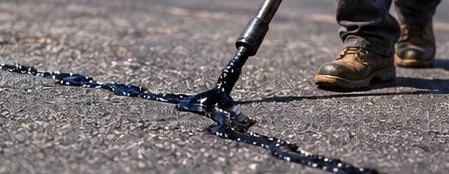
Asphalt cracks for a few reasons: age, sun, heavy traffic and ground movement. San Antonio has a lot of clay soil that swells when it gets wet and shrinks when it dries out, and that movement pulls pavement apart. Once a crack opens, rain runs straight into the base under the asphalt. The base softens, the pavement sinks, and the crack grows into a pothole.
Crack sealing stops that cycle. Boca Brothers seals cracks in parking lots, private drives and HOA streets across San Antonio.
Our crack sealing process
- Clean out the crack. Dirt, weeds and loose material are blown out so the sealant sticks to clean asphalt.
- Fill with hot-pour rubberized sealant. The material goes in hot, bonds to both sides of the crack and stays flexible, so it stretches and squeezes as the pavement moves through hot summers and the occasional freeze.
- Finish it flat. Sealant is leveled so it doesn't trip pedestrians or get torn up by tires.
Which cracks can be sealed
- Long straight cracks running along or across the lot are ideal for crack sealing.
- Edge cracks along curbs and the outside edge of the pavement should be sealed before they break off.
- Block cracking, where cracks form large rectangles, can usually be sealed if caught early.
- Alligator cracking, a web of small connected cracks, usually means the base underneath has failed. Crack sealing won't fix it. That area needs repair, and we will tell you so instead of selling you something that won't last.
Crack sealing before sealcoating
Sealcoat is a thin protective layer. It does not fill cracks or keep water out of them. That is why we always seal cracks first, then sealcoat the lot. Done together, they protect the pavement from both water underneath and sun on top.
What crack sealing costs
Crack sealing is priced by the linear foot. Wider cracks take more material, so they cost a little more per foot. We measure your cracks when we walk the lot and give you a written quote.
Common questions
What's the difference between crack sealing and crack filling?
People use the words interchangeably. What matters is the material. We use hot-pour rubberized sealant, which stays flexible and moves with the pavement instead of cracking out like cheap cold-pour filler.
When is the best time to seal cracks?
Any time the pavement is dry. Cooler months are ideal because cracks open wider when it's cool, so more sealant gets in. Sealing before summer also keeps rain out during storm season.
How long before cars can drive over sealed cracks?
Usually within an hour, once the sealant cools.
Will sealed cracks come back?
Pavement keeps moving, so new cracks will form over the years. Sealed cracks should hold for several years. Checking the lot every year or two and sealing new cracks keeps the pavement in good shape.
Can you fix alligator cracking?
Crack sealing won't fix alligator cracking because the base underneath has usually failed. We'll point out those areas so they can be repaired properly.